
What affects the cost of commercial concrete work?
Scope and type of work
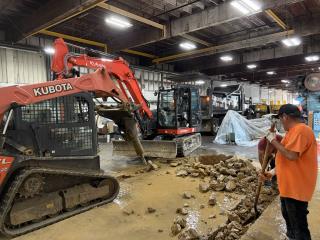
The type of concrete work sets the basic scope of a commercial quote. Marshall Construction's commercial concrete and asphalt services range from site work (parking lots, curbs, ADA ramps, sidewalks, storm drains, saw cutting) and structural work (foundation walls, footers, slabs, mat foundations, basement floors) to building and development work (industrial and commercial floors, multi-unit buildings, townhome developments, cast-in-place steps, dumpster enclosures) and site amenities such as light pole bases and sign foundations. Some jobs are replacements rather than new work: Marshall Construction's commercial garage floor project in Elkton, Maryland involved demolishing and replacing a section of the floor. Commercial asphalt adds its own scope items, such as paving, repairs, sealcoating and line striping.
Some commercial jobs span more than one group, combining commercial sidewalks, curbs, ADA ramps and storm drains with foundation walls and slabs, and Marshall Construction can handle site and structural concrete on one project with its own crew.
Schedule and the trades waiting behind the concrete
On a commercial project, the concrete schedule affects more than the concrete. Marshall Construction's view is that until the concrete is done, nothing else moves. Concrete is often one of the early trades, so a slow concrete crew backs up every trade lined up behind it. According to the company, that is why the commercial clients among the customers Marshall Construction works with first ask how fast a contractor can come look at the job, quote it, start and finish.
Owned equipment versus rentals
Marshall Construction does all commercial work in-house, with no subcontractors and no rental equipment. It owns a crane, wall panels in every size, excavators and dump trucks. The company says many foundation crews rent equipment, set panels by hand or borrow equipment from another job, and that this is how a foundation pour ends up holding up the rest of a build. Because it owns every panel size, the company says there are no rental windows and so no schedule risk from rented equipment.
Excavation handled in-house
Excavation and dump truck services are listed under commercial concrete and asphalt, one of the six services Marshall Construction offers, so site preparation on a commercial job is done by the same company as the concrete. On McMullen Square for the Wilmington Housing Authority in Wilmington, DE, Marshall Construction handled the excavation as well as the poured-wall foundations, sidewalks and driveways.
Ground conditions at the footers
According to Marshall Construction, when footers are dug and the soil turns out to be bad, the bad soil has to be dug out and filled with concrete, which is why soil conditions also affect the cost of a poured foundation. The company's position is that an honest contractor uses only the concrete the ground actually needs, and does not claim bad ground to sell extra yards of concrete.
Supplier timing
Marshall Construction does not own concrete trucks or an asphalt plant. It relies on 20-year relationships with material suppliers, which let it call in the morning and get a concrete truck the same day. The company says smaller operators wait three to four days for a truck.
Pour timing in hot weather
Marshall Construction schedules pours around temperature. On hot days, Kyle Marshall orders early-morning concrete trucks, because he says that is when concrete behaves best.
Insurance and bonding requirements
Commercial jobs can come with specific insurance and bonding requirements, and meeting them is part of choosing a commercial concrete contractor. Marshall Construction is licensed, bonded and insured, says it meets every insurance requirement for commercial projects, and can raise its bond as needed for a specific job.
Getting a commercial quote
Property owners and general contractors can request a free estimate from Marshall Construction, and commercial quotes are turned around in 24–48 hours. Kyle Marshall, the owner, is on site controlling the work.

